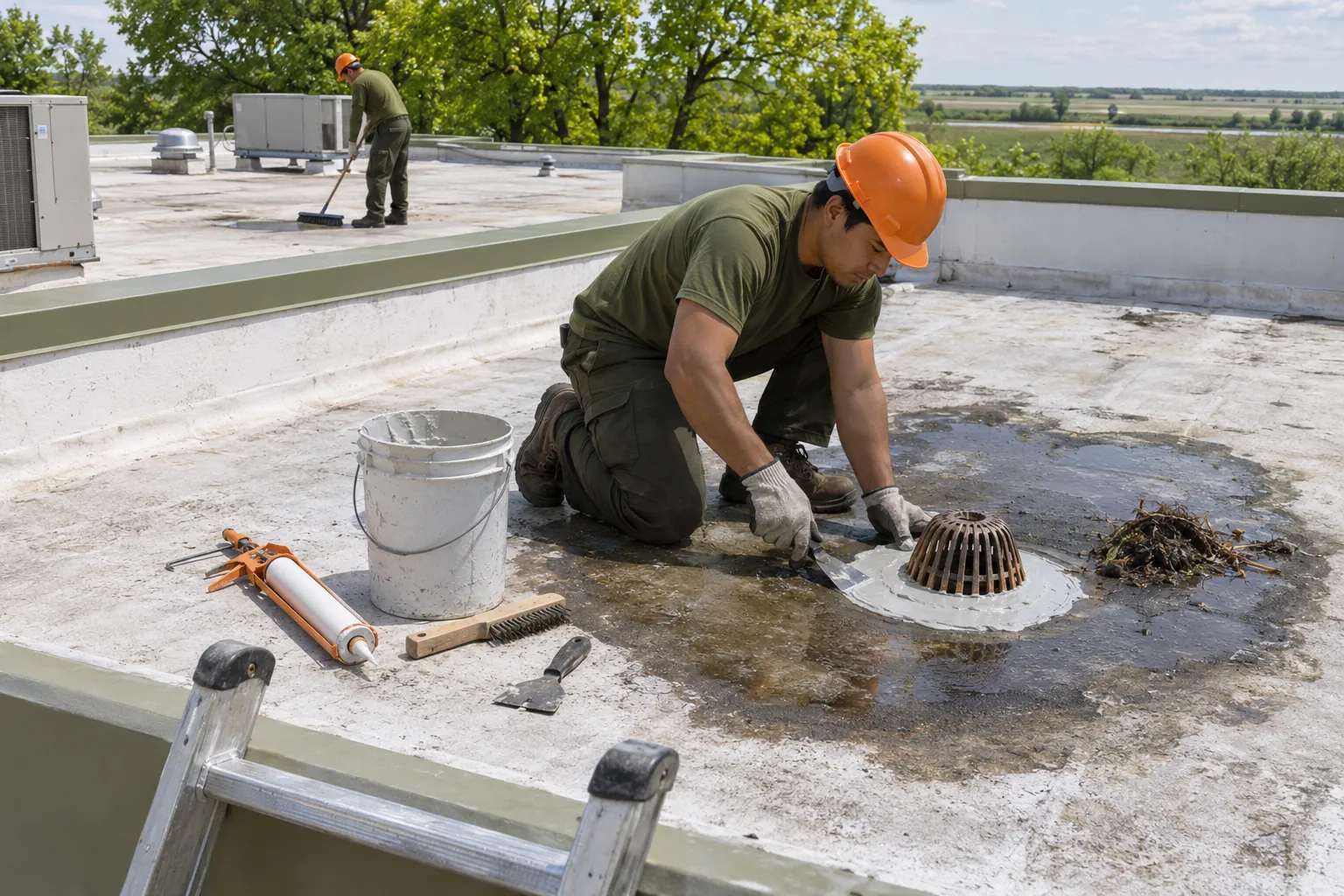
Flat Roof Repair
Open seams, punctures, and failed drains on membrane roofs are the most common sources a trace turns up.
Flat roof repair in Kearney
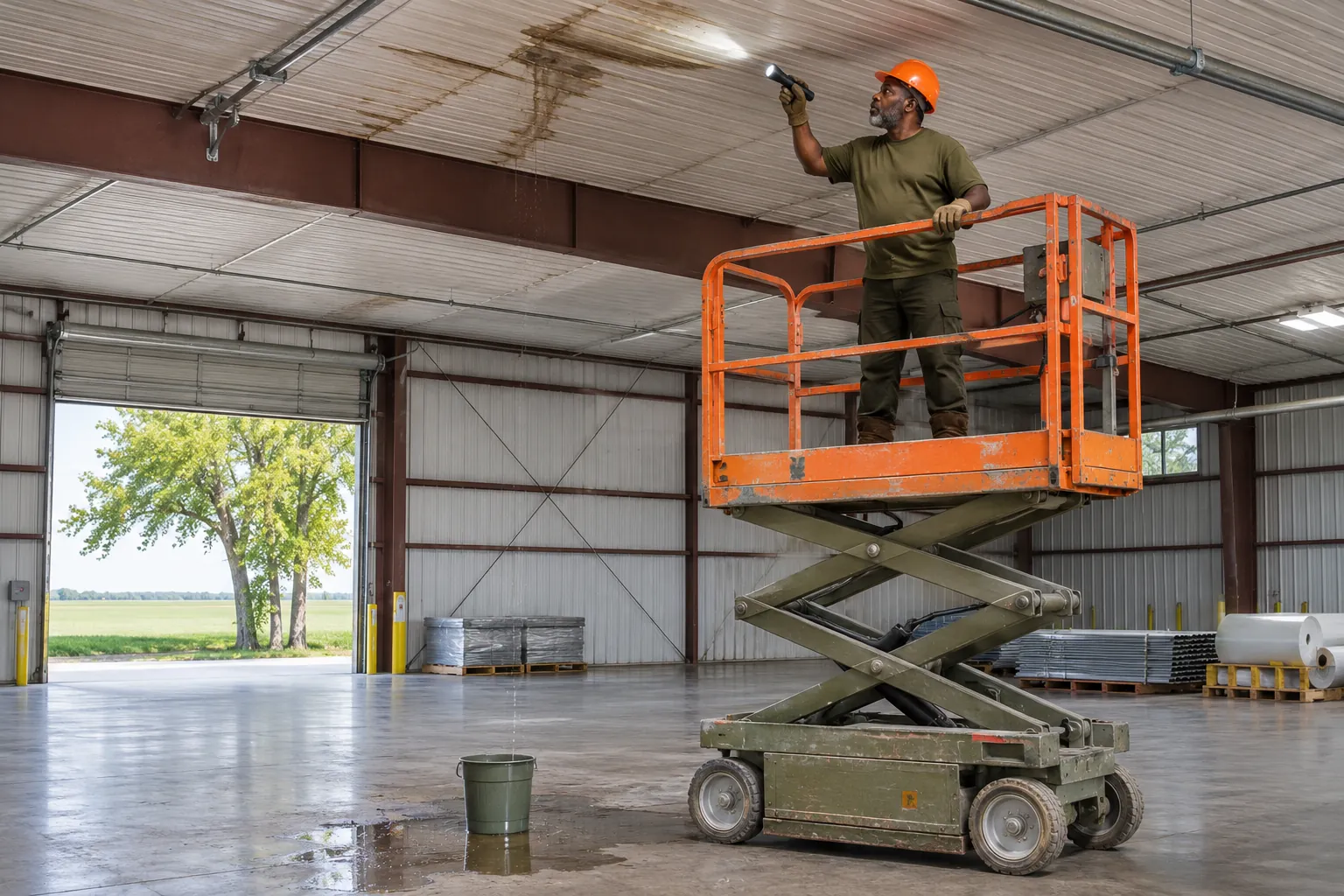
As a Kearney commercial roof leak repair contractor, we trace water from the stain back to its entry point and repair that spot on the roof.
Kearney commercial roof leak repair starts with one question: where does the water get in? These lists show when tracing and a local repair fit, and when the roof needs more.
Inside the building, a leak leaves clues. Reading them correctly keeps the repair aimed at the right spot on the roof.
Water enters at a seam or flashing upslope, then runs along the deck or insulation before it drops.
We mark the drip point inside, trace upslope on the roof, and repair the entry point we find there.
Short or cracked curb flashing, loose access panels, and failed gaskets let wind-driven rain into the unit and ducts.
Curb flashing gets raised and resealed, cabinet seams and gaskets are closed, and condensate lines are routed to a drain.
Melting snow backs up at blocked drains and parapets, then reaches seams and flashing that rain alone never touches.
We clear drainage paths and seal the high-water seams and wall flashing that the melt reached.
Hail cracks membranes, splits seams, and breaks the sealant at metal laps, often where it is hard to see.
A roof walk documents each impact with photos, and we repair the cracked membrane, seams, and laps.
Wind lifts membrane edges, loosens edge metal, and peels wall flashing at corners and perimeters first.
We secure the edges and coping, reset the flashing, and seal lifted membrane before the next rain.
Most leaks start at a handful of roof details. We check them in this order because water most often enters there first.
| Roof Detail | What Fails | How We Test | Repair |
|---|---|---|---|
| Rooftop unit curbs | Low or cracked flashing | Visual check, then water test | Reflash and seal the curb |
| Seams and laps | Open welds, lifted tape | Probe the lap edge | Clean, prime, and cover strip |
| Wall and edge flashing | Lifted or torn flashing | Check the windward walls | Reset and terminate the flashing |
| Drains and scuppers | Cracked bowls, loose rings | Flood test at the drain | Reset the ring or replace the bowl |
| Skylights and pipe boots | Cracked curbs and boots | Water test in sections | New boot or curb flashing |
A leak that keeps dripping does more damage every week. Here is what an early repair stops.
Hidden hail cracks let water into insulation for months before a stain shows inside.
A documented roof walk finds the impacts early, while repairs are still local.
Leaks that travel along the deck rust it and soak insulation well away from the drip point.
Repairing the entry point stops that spread and keeps the wet area small.
Each drip risks wet inventory, damaged machines, and slippery floors where staff walk.
A traced, finished repair lets you move stock back under that part of the roof.
Patching the drip point instead of the source means the same leak returns with the next storm.
Repairs logged by location show whether a fix held and where to look first next time.
Move stock and catch the drips, then call us. These notes help us find the entry point on the first visit.
Leak repair is a search first and a repair second. Here is how we find the entry point and close it.
Starting inside, we mark every drip point and stain, then walk the roof above and upslope of each one.
Water travels along panels and insulation, so we check flashings, seams, and penetrations first and water test small areas in sequence when needed.
The repair goes where water enters the roof, such as a reflashed curb, a closed seam, a new boot, or reset edge metal.
After the repair, we check the marked drip points during the next rain or with a water test and log the result.
Once the entry point is found, the fix usually falls under one of these repairs.
Open seams, punctures, and failed drains on membrane roofs are the most common sources a trace turns up.
Flat roof repair in Kearney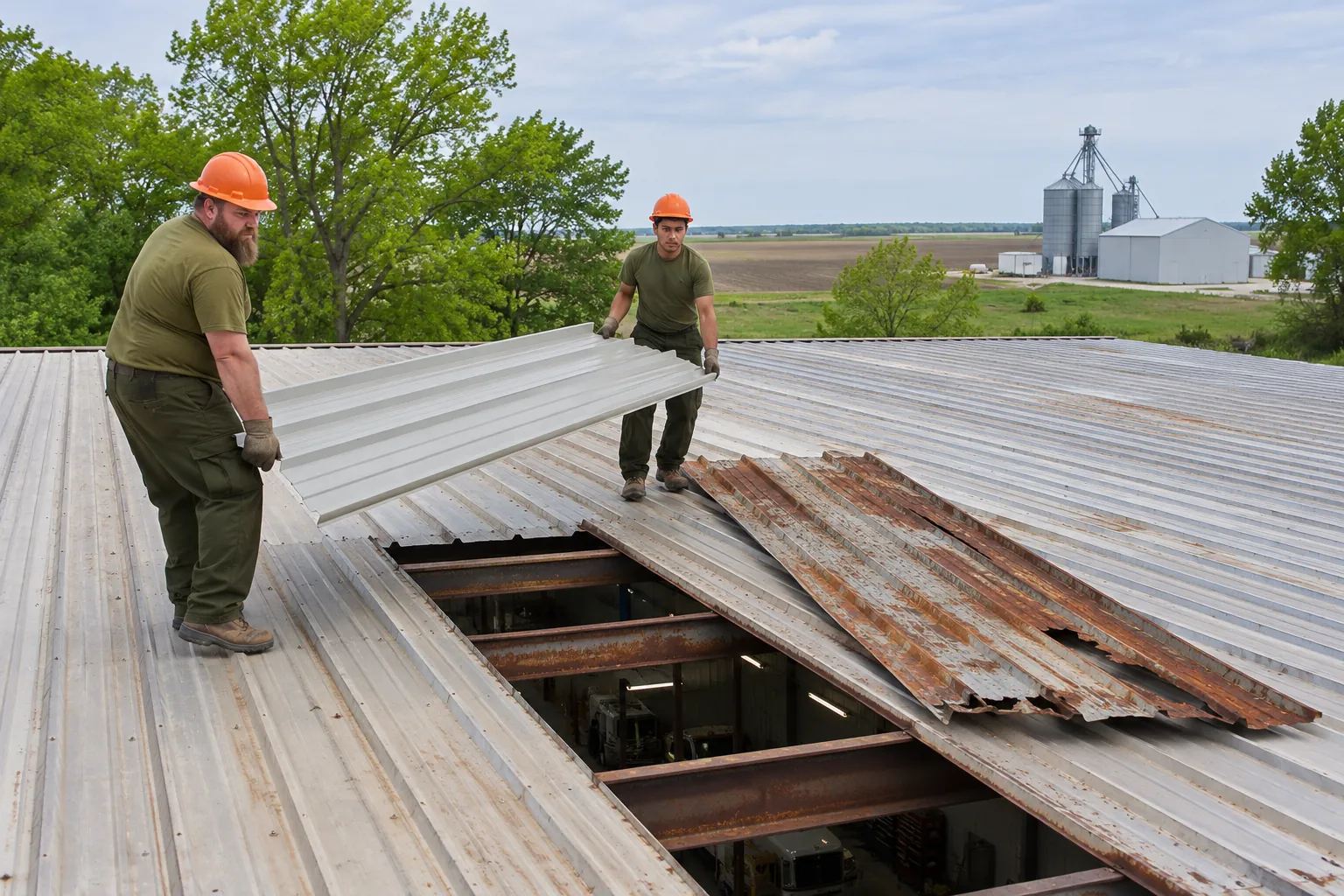
Traces that end at fastener rows or laps lead to new screws, lap sealant, or a replaced panel.
Metal roof repair in Kearney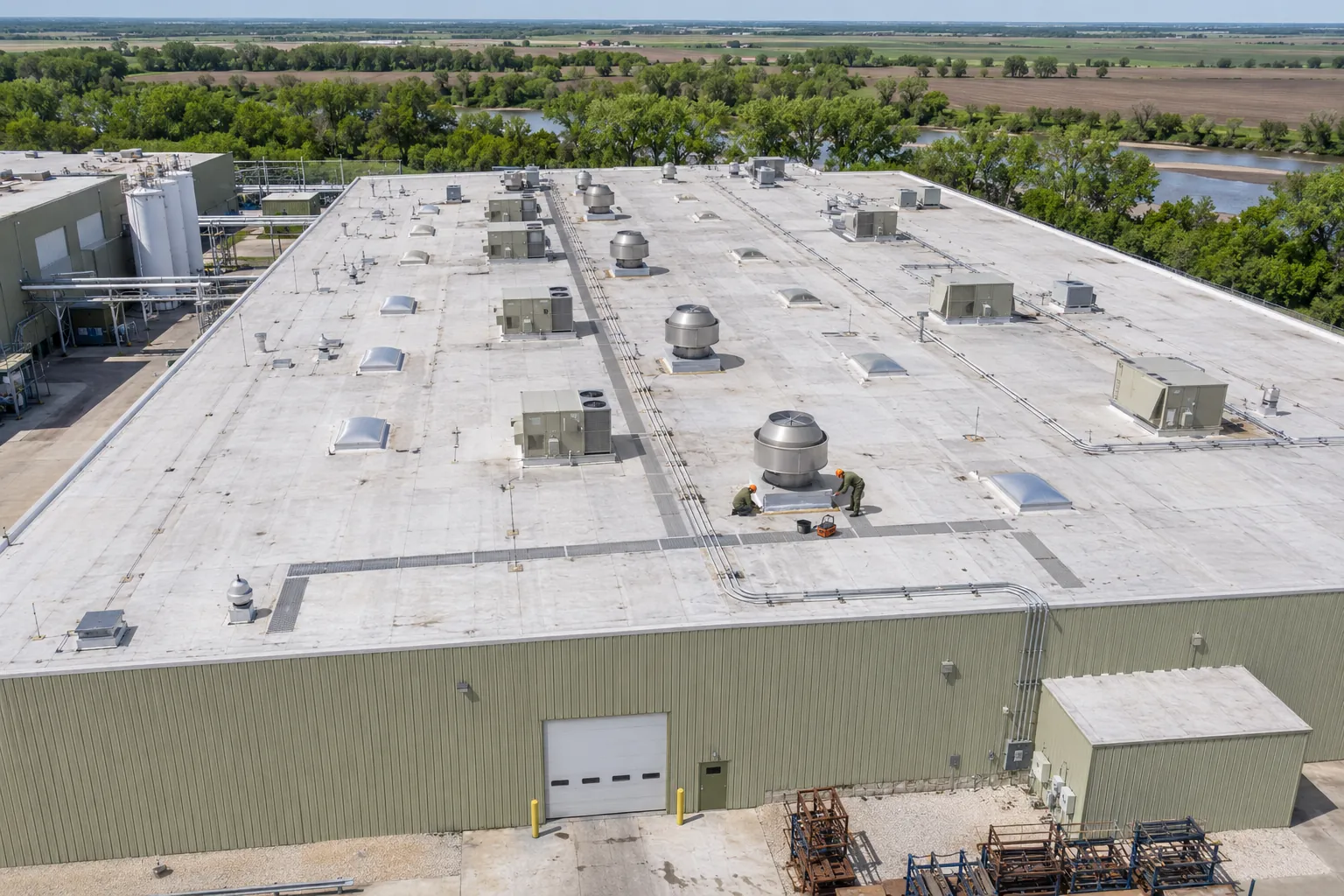
Entry points at fan curbs and stacks on plant roofs need materials matched to process discharge.
Industrial roof repair in KearneyAnswers on leak cost, finding leaks, rooftop units, hail, and wind damage for Kearney buildings.
Mostly because of how long the search takes. One failed curb flashing is quick to repair once it is found, while water that travels along the deck or insulation takes more tracing. Anything uncovered along the way, such as wet insulation or a rusted deck, adds to the repair.
Start inside by marking every drip point and stain on the deck. On the roof, trace upslope from those marks, because water runs along panels and insulation before it falls. Flashings, seams, and penetrations get checked first, and small areas are water tested one at a time when the source is still unclear.
The fix sits at one of three places: the curb flashing, the cabinet seams of the unit, or the condensate line. Curb flashing has to be tall enough and sealed. Loose access panels and failed gaskets let wind-driven rain into the ducts, and condensate lines that empty onto the membrane get rerouted to a drain.
Hail cracks membrane, splits seams, and breaks sealant at metal laps, and much of that damage is hard to spot from the ground. The National Weather Service in Hastings recorded hail over 4.5 inches in Kearney on June 12, 2002, with roof damage. After a storm we walk the roof and photograph each impact.
Check for membrane edges that have lifted, loose edge metal, missing coping, and peeled flashing. On metal roofs, look for bent panels, popped screws, and loose ridge caps. Corners and perimeters take the strongest wind, so damage usually starts there, and small lifts should be secured before the next rain gets under them.
Tell us where the water shows and what weather brings it. We will trace the leak and price the repair in writing.