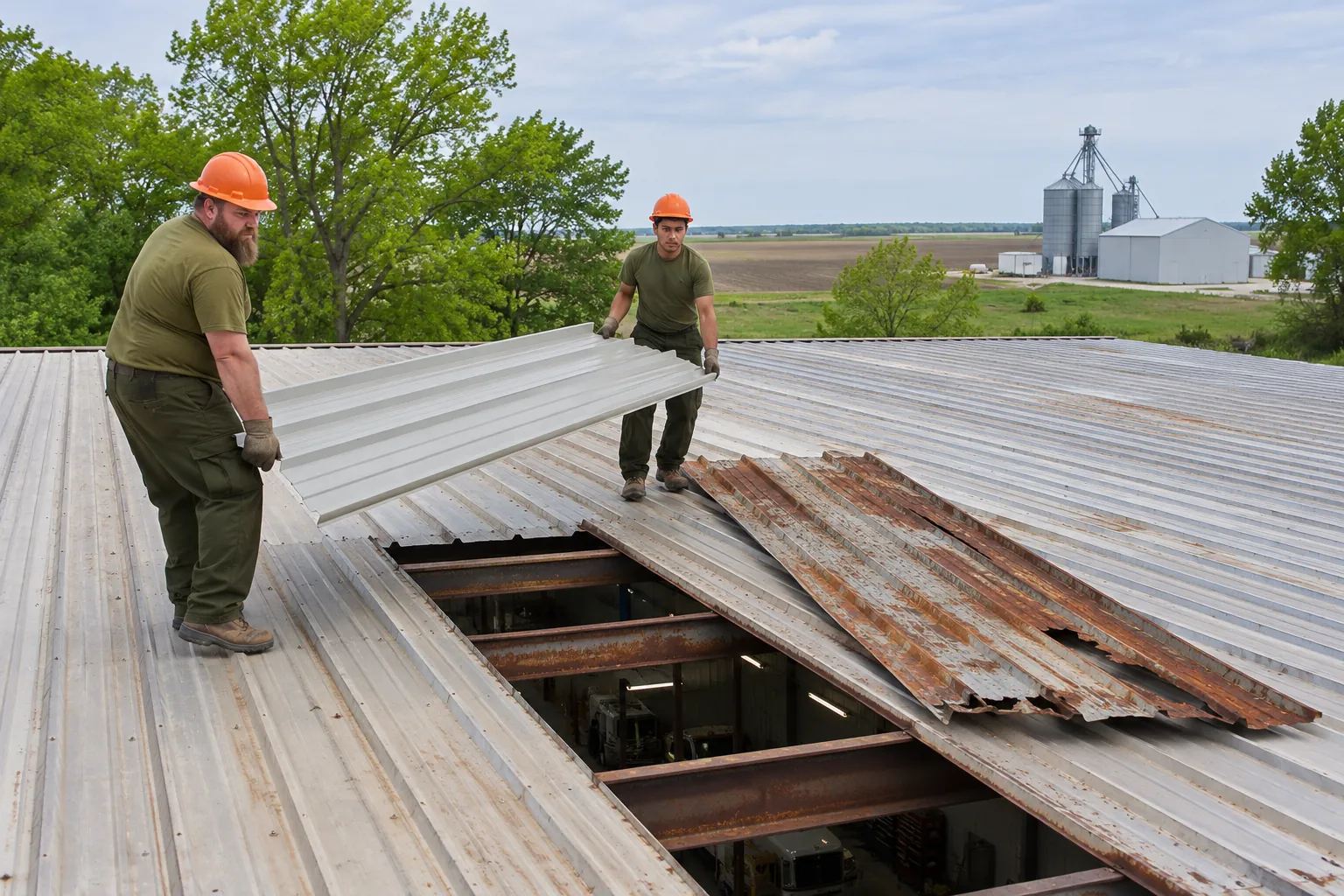
Commercial Metal Roof Repair
Metal additions and canopies on flat-roof buildings leak at screws and laps, which get new fasteners and resealed laps.
Metal roof repair in Kearney
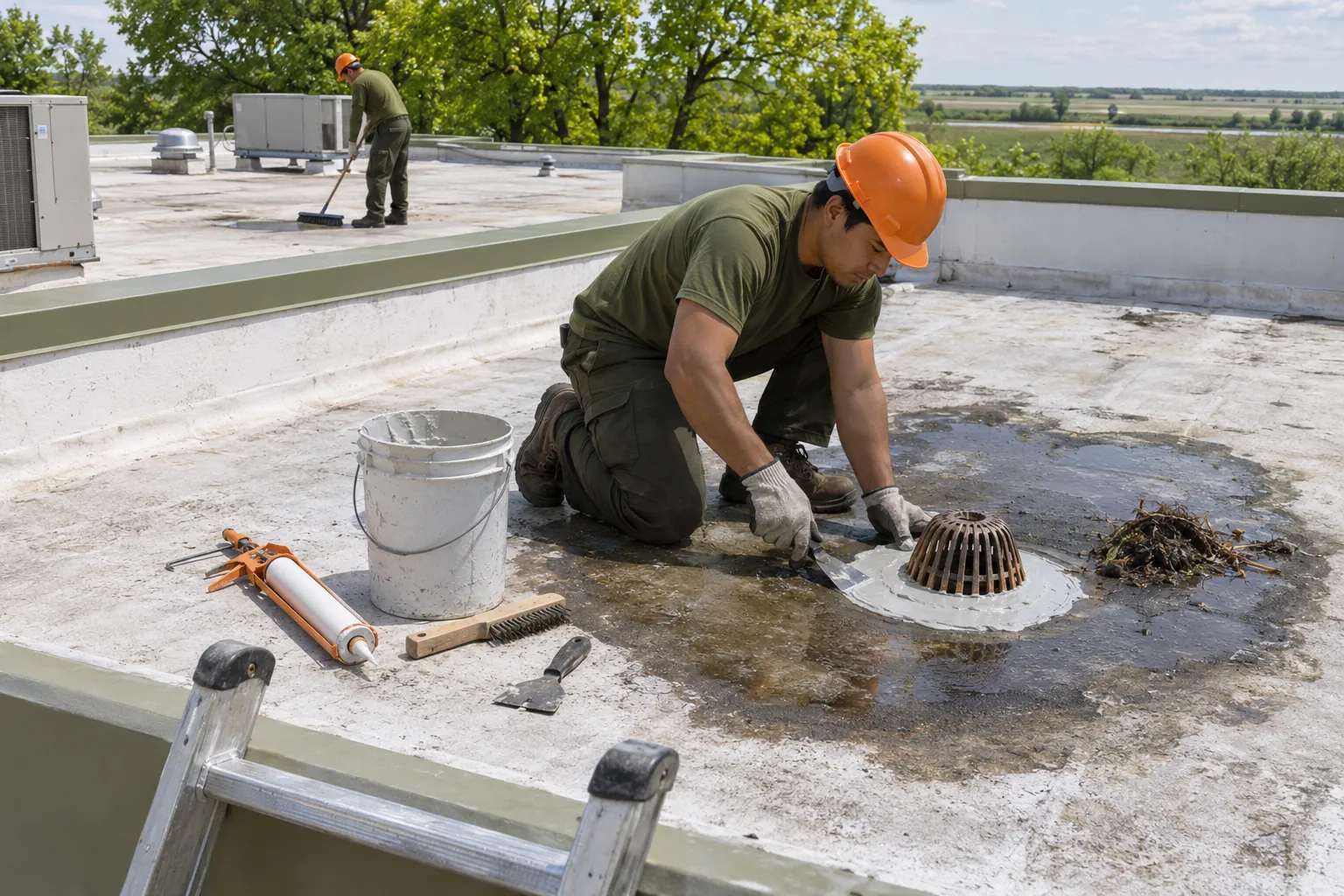
As a Kearney flat roof repair contractor, we fix open seams, punctures, and drains on TPO, EPDM, modified bitumen, and built-up roofs.
Kearney flat roof repair works when the damage is local and the membrane still bonds. These two lists show when a repair fits and when a section or the whole roof needs replacing.
These are the flat roof failures we see most on Kearney stores, offices, and warehouses, with the cause behind each and the repair that follows.
Debris in the strainer, a drain bowl set above the low point, or a sagging deck keeps water on the roof.
We clear and reset the drain at the true low point and add a cricket or tapered insulation to push water toward it.
Heat cycles and foot traffic break the adhesive or weld at the lap until the edge lifts.
We clean and prime the lap, then cover it with matching membrane that runs well past the open section.
Service traffic, dropped tools, and hail leave small holes around units and walkways.
Each hole gets a cleaned, primed, round-cornered patch, and we add walkway pads where service techs walk most.
Insulation under the membrane soaked up water from an old leak and lost its strength.
Moisture readings and core cuts map the wet board, which we cut out and replace before closing the membrane.
Water in small openings freezes, expands, and pries flashing and sealant apart with every freeze-thaw cycle.
We reseal termination bars and reflash walls and curbs, then schedule a spring check to catch what winter opened.
Each flat roof system takes its own repair materials. Matching them is what keeps a patch stuck to the roof.
| Membrane | Common Failure | Repair Method | Watch For |
|---|---|---|---|
| TPO | Open heat-welded seams | Hot-air weld of a matching TPO cover strip | Older TPO that will no longer take a weld |
| EPDM | Lap seams and tape lifting | Seam primer and cured cover tape | Shrinkage pulling at walls and curbs |
| Modified bitumen | Cracked laps and blisters | Torch or cold-applied cap sheet patch | Granule loss that exposes the base sheet |
| Built-up (BUR) | Splits and an alligatored surface | Felt and asphalt patch with new surfacing | Wet plies under the gravel |
A small opening on a flat roof keeps growing until it is fixed. Here is what each repair stops.
Standing water adds weight, wears the membrane faster, and freezes against seams near the drain each winter.
Reset drains and tapered crickets keep water moving to the outlet.
Patches laid over brittle or wet membrane let go because the adhesive has nothing firm to grip.
A bond test decides: patch where the membrane holds, replace the section where it fails.
Leaking laps send water across the deck and into ceiling tiles far from the seam itself.
Covered laps close the path, so the interior repairs below can stay finished.
Trapped water keeps rotting the deck and soaks new patches from below.
Cutting out wet board and replacing it gives the new membrane a dry, firm base.
Tell us how long the water sits and where it collects. These details help us plan the first visit.
Flat roof repairs follow the water: inspect the roof, find the cause, repair it, then confirm the roof drains.
We walk the field, edges, and every penetration, and take moisture readings wherever the membrane feels soft or a stain shows below.
Drains come apart, get cleaned, and go back in with new sealant at the low point, and crickets go in where water runs the wrong way.
Clean, primed membrane gets a matching patch, while brittle or wet areas are cut out and rebuilt with new insulation and membrane.
Once the work is done, we look at the roof after the next rain to confirm water leaves and the repaired seams stay closed.
Flat roofs share buildings with metal roofs, rooftop units, and plant equipment. These repairs often come up on the same property.
Metal additions and canopies on flat-roof buildings leak at screws and laps, which get new fasteners and resealed laps.
Metal roof repair in Kearney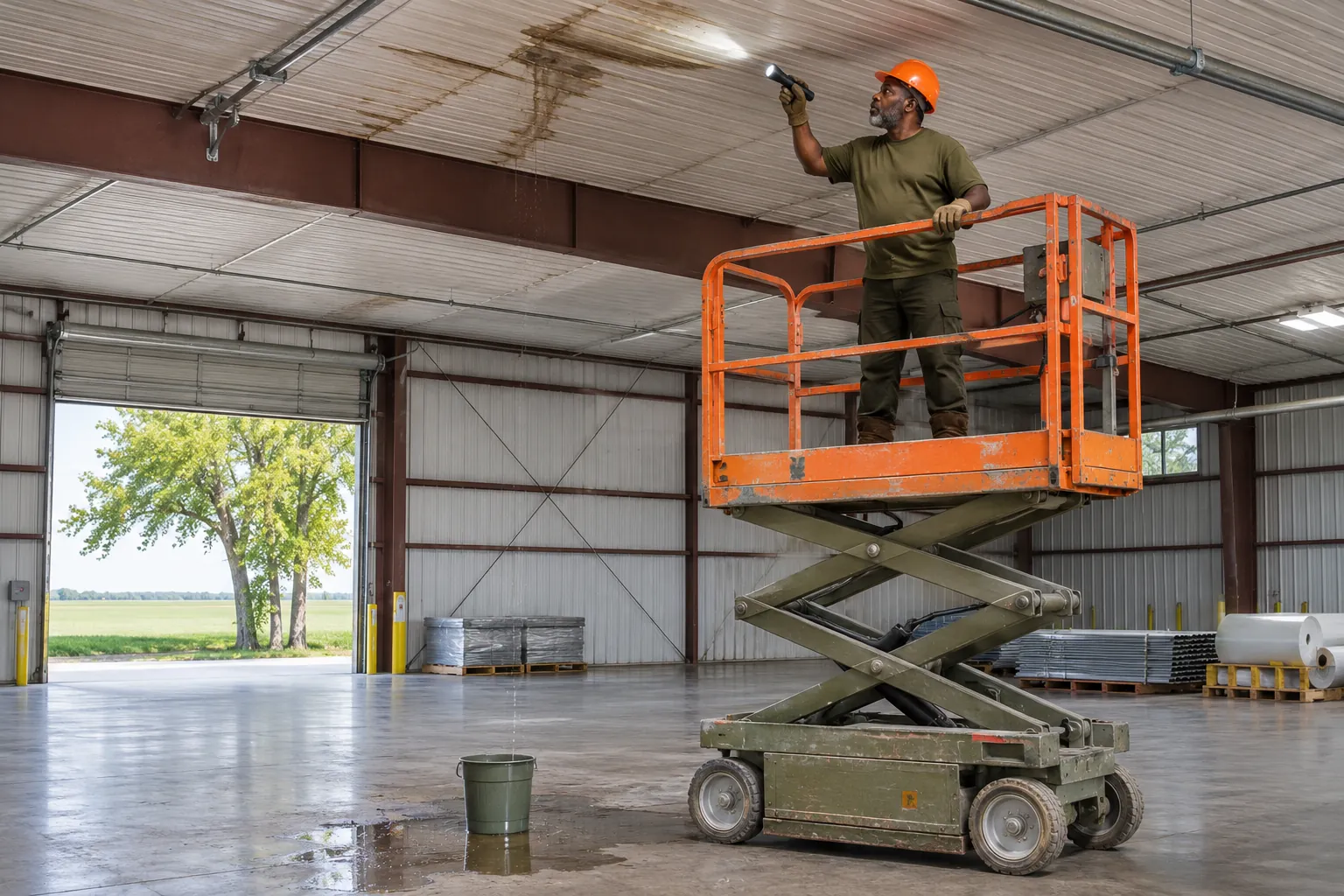
When a stain shows up with no clear opening above it, leak tracing finds where the water actually gets in.
Roof leak repair in Kearney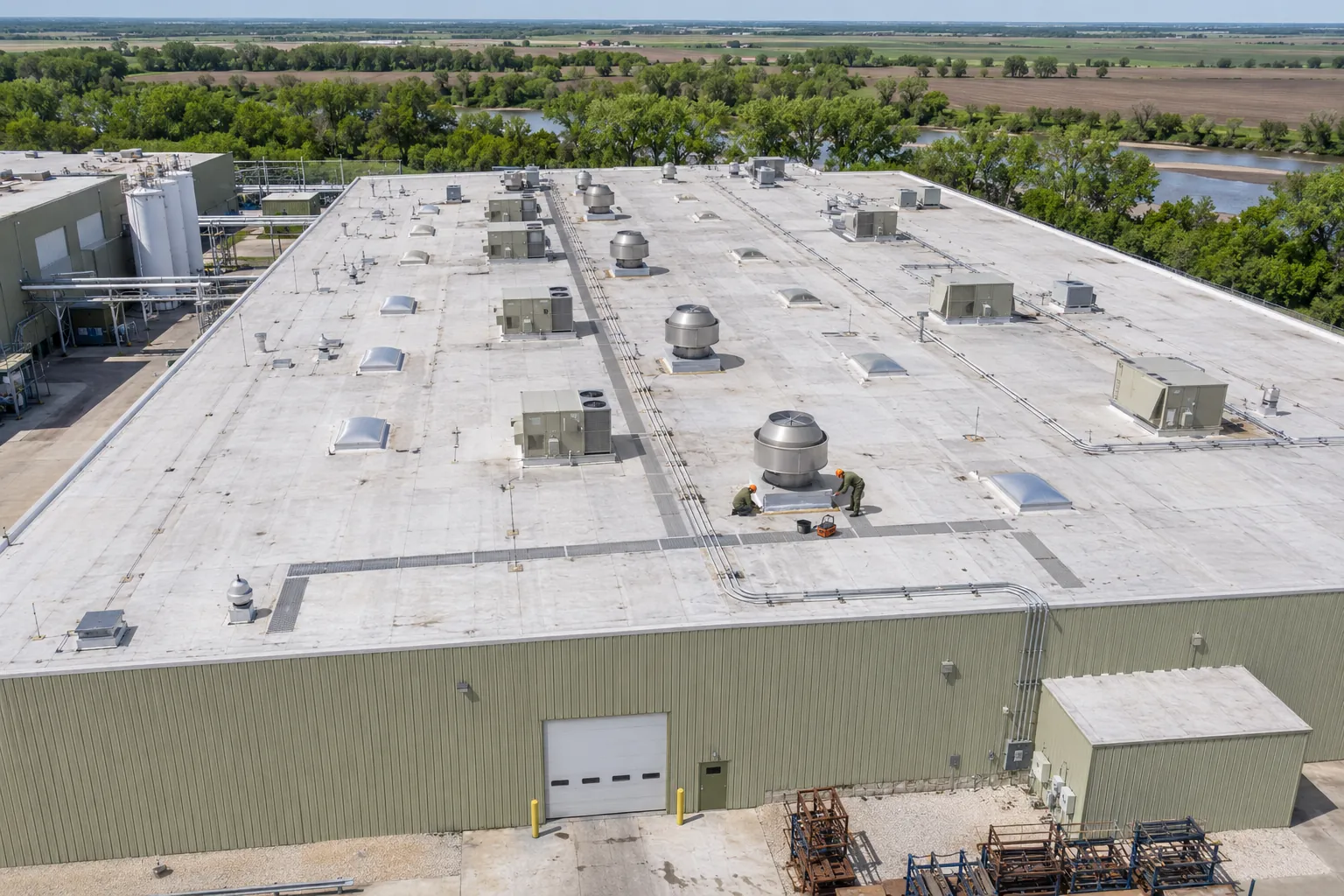
Plant roofs with exhaust fans and heavy equipment need flashing and membrane suited to discharge and dust.
Industrial roof repair in KearneyStraight answers on flat roof cost, ponding, patches, and drains for Kearney building owners.
Price follows the membrane, the number of repair areas, and how much wet insulation has to come out. TPO, EPDM, modified bitumen, and built-up roofs each take different materials. Fixing ponding with tapered insulation adds to the job, and so do hard roof access and equipment that has to be moved first.
By fixing drainage. Drains get cleared and reset, crickets or tapered insulation go in, and low spots in the deck get corrected. Water that sits for days ages the membrane early and adds load to the deck, and in winter it freezes against the seams closest to the drain.
A patch holds when the membrane around the damage still flexes and bonds. The area gets cleaned, primed, and covered with matching material that extends past the damage. On brittle, chalky, or wet membrane the adhesive has nothing to grab, so that area gets a section replacement after a failed bond test.
The clamping ring comes off, the bowl gets cleaned, and the membrane is reset with fresh sealant. Cracked bowls and broken strainers are replaced. We also check that the drain sits at the true low point with insulation tapering to it, and clear any clogged leader inside the building.
Water gets into small openings, freezes, and expands, and each cycle opens seams a little wider, cracks sealant, and lifts flashing. Frozen ponding near a drain can block it entirely. Sealing small gaps and clearing drains in fall limits the damage, and a spring check finds whatever winter opened.
Send us the membrane type and where the water sits or drips. We will inspect the roof and price the repair in writing.